Back
|
Back
|
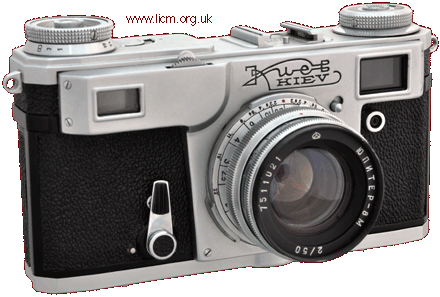
| Kiev 4A, 35mm rangefinder camera, c1958, this example 1975 |
|
The Kiev 4A is a Russian produced rangefinder camera for 35mm film produced from 1957, although earlier relatives existed from 1946-48(sources vary). That short sentence hides a fascinating history though and it would be most remiss not to précis it. At the start of the 1930s the convergence of high quality panchromatic film emulsions, refined optics and manufacturing lead to the practical use of 35mm movie film for still cameras, as proved by the Leica. Add to this the immediacy of a coupled rangefinder allowed the camera to get the best out of what was a small negative. By the end of 1934 Kodak had introduced the Daylight Loading Casette, a 3ft length of 35mm film wound into a tin sealed with felt and known as 135 in Kodak parlance and the 35mm revolution was about to take off. Zeiss Ikon based in Dresden Germany elected to join the party early on in 1932, producing the the superb Zeiss Contax 35mm rangefinder that year. It was a no-compromise and expensive professional camera with a very long rangefinder base to give exceptional focus accuracy, bayonet mounted lenses and a vertically running metal roller blind shutter. The design evolved by 1936 to become the Contax II and things looked good for the Zeiss Contax... were it not for a certain major conflict that broke out in 1939. Five years later as Nazi Germany collapsed during 1945 the Soviet Red Army swept up Dresden and the plethora of German photographic and optical industries based there. Whilst much of what they found remained in Dresden, later forming the basis of VEB Pentacon, the tooling, unfinished components and even some of the staff of Zeiss Ikon were shipped to Kiev in Soviet Ukraine. All this was put to work at Kiev Arsenal where the first camera was built c1948, although some cameras were built in Dresden prior to the move to Ukraine. Unlike the efforts of FED to produce Leica clones, these Contax II and Contax III(metered) based Kiev's were in most respects Zeiss Contax cameras, built using the same tooling and techniques employed by Zeiss Ikon. The design evolved in detail respects, becoming the Kiev 4A around 1958 but was recognizably the same up to the end of production with the Kiev 4am in c1987. Kiev 4 and 4A(no meter) are the most commonly found variants as these had the longest production run. The unmetered versions are better looking than the versions with the large boxy selenium cell housing and for this reason we had been looking for a decent example for a while. This one was donated by C. Saunders in memory of her brother Stephen who passed away unexpectedly in November 2024. The camera is cosmetically very tidy and appeared to be working just fine so after a light cleaning was added to the collection and given an outing. |
|
 |
|
Body No. 7502702 (hence the 2702nd made in 1975) View other rangefinder cameras in this collection.
|

|

|

|

|
 |
© Living Image Vintage Camera Museum 2000-2026