Back
|
Back
|
| Voigtländer Vitomatic II, 35mm rangefinder camera, image gallery |
|
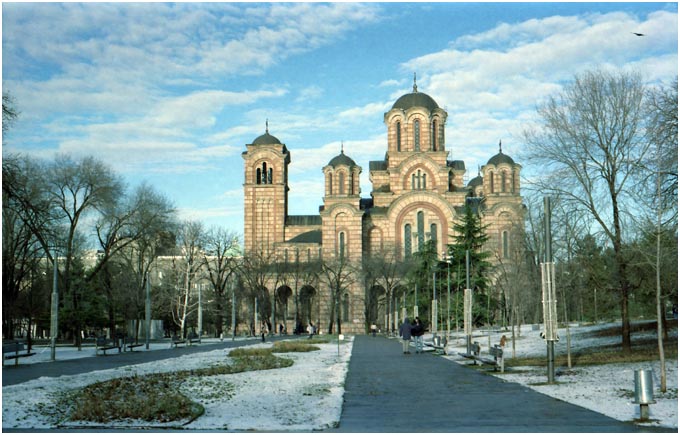
The Vitomatic is the third member of the Vito family to be held in the collection and is identical optically to the other two. Despite this I wanted to give it a treat and in 2024 it was allocated three films from the fridge. This first image is of St Mark's, a large Orthodox church in Belgrade in January 2024. This was the first bit of sun of the year, but it was generally a mild winter with little snow, just enough to brighten up the gardens in the watery mid afternoon sun. Compared to the churches I'm familiar with in the UK, this one is a youngster, being completed in 1940. I disregarded the meter for most exposures with the Vitomatic, although it seemed to show willing, the readings never seemed sensible to me and I simply did my own thing, opting for 1/50th at half a stop under f/8 for a 200ASA film. Looks about right to me. The images on this page are mostly full frame. |

|
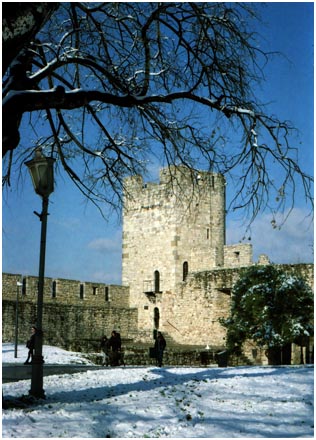 |
Belgrade Fortress is probably the most attractive part of Belgrade, the site having several stages of occupation over the centuries, guarding the confluence of the Sava and Danube rivers. The Vitomatic renders the images just the same way the other Vito's do. The rangefinder is a little tricky to use, you need to concentrate to find the superimposed image as the tinting is very subtle and it's quite small. But it works and does the job. |
|
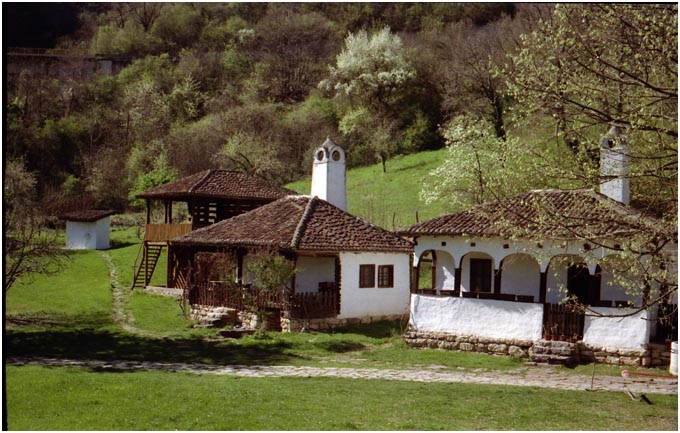
Later in the spring in idyllic rural Serbia. Actually these buildings are restored and form part of the Lepenski Vir Mesolithic settlement archaeological site |
|
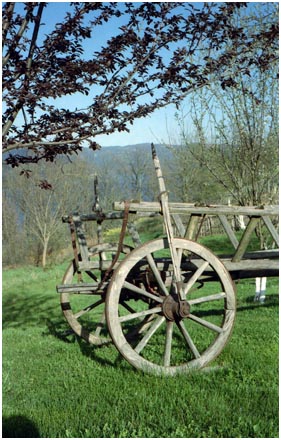
The rangefinder is good enough to pick your focus point, although not as rapidly as a camera with a longer rangefinder base, you'll find yourself going in and out a couple of times before being certain. |

|
A change of location to Ausgarten in Vienna. I always feel the need to visit Ausgarten when visiting Vienna. Amongst the well kept flower beds, neat paths and perfectly trimmed rows of shrubs and trees, this alien spaceship towers over the park keeping watch. The tower is in fact a WW2 anti aircraft "flak" tower, scarred with shell and small arms fire impacts, streaked with rust leaching from it's hastily constructed ferro reinforced concrete body. It's magnificent, intimidating and poignant in equal measures. The locals barely give it a glance, and I often wonder if they deliberately ignore it, so fixed their gaze as they go about the park. It was one of several around the city, constructed to dissuade allied bombers from their missions. |

|
 |
At left, the other flak tower in Ausgarten is this taller rectangular structure. This one isn't quite so heavily damaged and doesn't have quite the presence of the other, but does make for the occasional graphic image, of which I am always fond. The right hand image shows the tatty end of an old Wien Tram awaiting it's turn to be restored in the Transport museum. Using the Vitomatic's rangefinder to make sure all the cracking paint around the Tram's number is clearly recorded. |
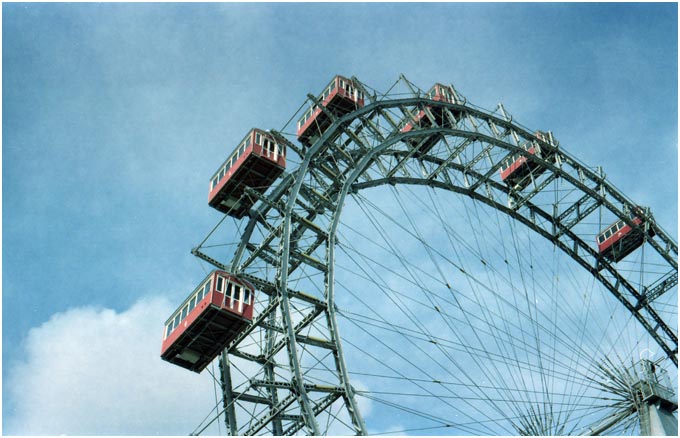
|
The world's oldest Ferris Wheel opened in July 1897 is to be found in Vienna. It was built to celebrate the golden jubilee of Emperor Franz Joseph I. A leisurely orbit takes around 25 minutes and you can choose to take one of the private restaurant cars and take a full orbit for each course. |
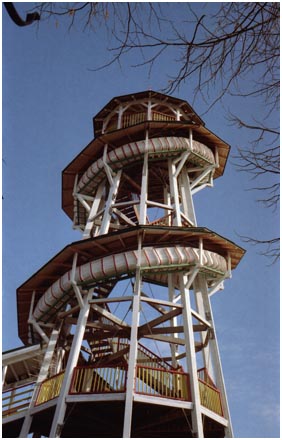
|
Within the same fairground at Pratter is this relative newcomer dating from 1913, the Vitomatic would come along 45 years later, then wait another 68 before getting the opportunity to photograph it. I rather fancy a go on it, but sadly it's never been open when I walk by in winter. |

|
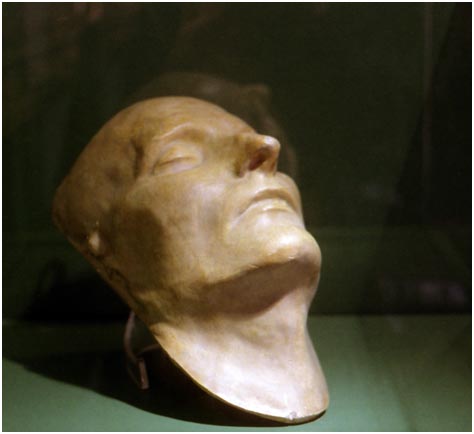 |
The expression "he met his Waterloo", refers to the defeat of the French Emperor Napoleon at the battle of Waterloo in 1815. Here is Napoleon's death Mask and to the the left, the fields of Waterloo upon which Napoleon's reign was finally crushed. |

|
French artillery pieces on display but actually nearer the site of British forces, but that's a minor point. Especially given that these are all glass fibre film replicas that look great, but don't survive the tap test. |
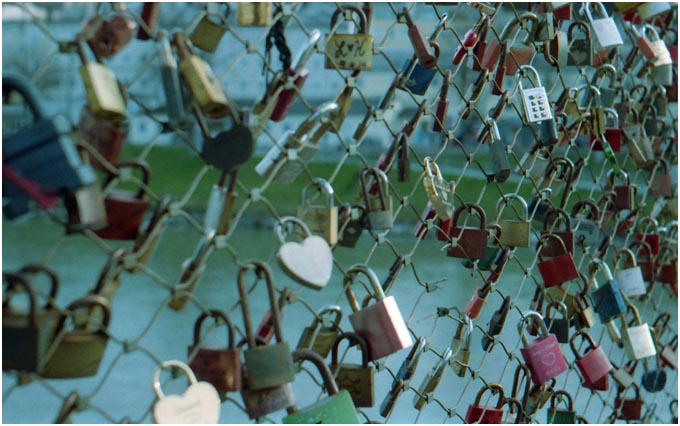
|
The trend of attaching padlocks to bridges and casting the key to the river is illustrated here by this bridge in Salzburg, Austria. Amongst the faceless, innumerable gestures of love lies this more telltale and tragic artifact. A padlock can be closed and the key cast to the river with joyous, gratifying immediacy. The planning and effort to take a pair of wire cutters and hack a padlock from the wire, leaving the shredded, sharp and twisted ends on display is altogether another, maybe more interesting, tale. The padlock is gone, but the hole it leaves bears testament and a scar that can never be healed. |
|
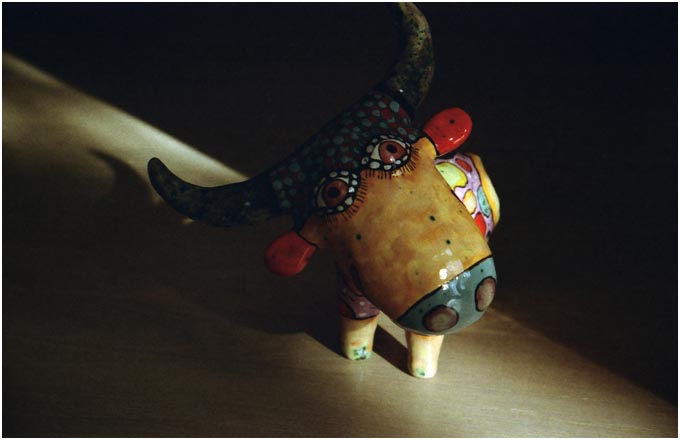
This is Moo. She was bought from the sculptor on Andrewskaya Descent, Kyiv, Ukraine, in 2019. She was a conscious and long considered purchase, but was then abandoned for two years during Covid. Briefly reunited to be left once again as Putin and his thugs tore through that beautiful city. Moo made it through surprisingly and now lives in Belgrade, Serbia where she was photographed to test the Vitomatic's close up attachment. She's reciting a line from Dire Strait's "Romeo and Juliet" - "steps out of the shadows and says, you and me babe, how about it?" |
|
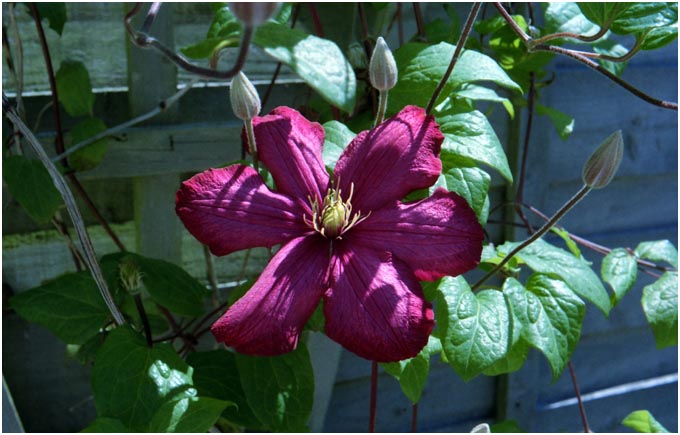
The final frame of the last roll was expended, again using the close up attachment, to record this Clematis welcoming me back after four months away. Whist not every image was compositionally interesting, every image came out, the only limitation being the photographer, well done Voigtlander - another little gem. |
 |
|
|
 |
||

|
||
© Living Image Vintage Camera Museum 2000-2026