Back
|
Back
|
| Rietzschel Kosmo Clack, stereoscopic plate camera, results gallery. |
|
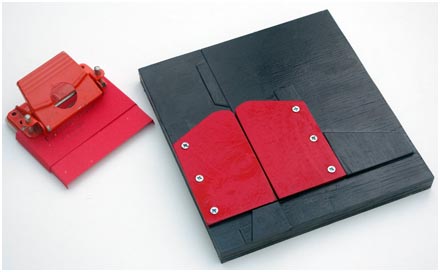
The Kosmo Clack has a number of approaches to making images and the quality of the camera made it worthwhile to explore these. Photographic material for the Kosmo Clack is all but extinct, so using this camera was always going to be a bit of a challenge. The first step was to locate plate carriers as the camera didn't have any when it joined the collection. Finding a set of five serviceable carriers in the Netherlands proved the catalyst to restoring the camera to working order, as it had merely been a pretty display case object since it arrived. With these two hurdles removed, there remained how to create the sheet film. For this sheets of 9 x 12cm cut film are truncated and cut in half. Initially this involved a rotary guillotine with preset stop guides and associated failure rate of about 30%. This was far from ideal but served to prove that the camera would be worth the time and effort so the mad creation at left was born. This is a guide that enables a surgical scalpel to be wielded in complete darkness whilst maintaining a sporting chance of keeping my fingers. The hole punch is used to notch the top right corner of the sheet now without an emulsion guide, a paper sleeve serves as a guide and prevents the sheet going in too deep. For those that aren't aware, modern sheet film is notched in the top right corner with the photographic emulsion facing you, so you know which way to load it in complete darkness. Sometimes I think there's a frustrated inventor living inside me. But it works fine, the failure rate vastly reduced and the sheets are way more accurate and consistent. And I have all my fingers. |
|
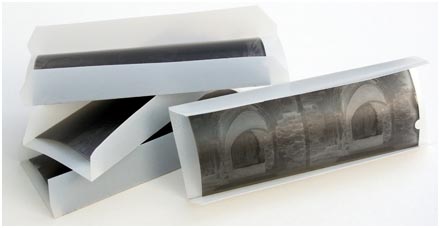
You can see one of the notches previously mentioned in this image, also visible in the full negative area scans further down the page. The plate carriers were modified with stiff inserts to account for the lack of glass. Originally the camera was intended for glass photographic plates, which are rigid. Sheet film, whilst on a fairly stiff polyester base, is far from rigid enough. The plates used for 107 x 45mm format were incredibly thin, in the order of 1mm. I found a sheet of 0.8mm sheet steel worked best, this is painted matt black to prevent the projected image from bouncing back into the film during exposure. Loading the carriers is a rather fiddly task as the grips are tiny compared larger carriers. Then there is the challenge of processing as I don't have any tanks for this size and whilst open tray processing is entirely reasonable, it's not my favourite way to spend half an hour. Accordingly I cooked up my own processing carriers from cut up milk bottles, seen at left. The carriers themselves are created slightly narrower than the sheet in order to flex it and keep it in place, this allows the chemistry to flow freely behind the sheet. |

|
These carriers are then loaded into a "modern" (c1970s) daylight Paterson Tank, one of the tall ones intended for two 120 roll films or four 35mm films. Using two internal spiral halves produces a variable holder to keep the processing carriers from moving around too much. I load the plates emulsion out, the elastic band is optional but in practice I have found it to be superfluous. The tank will take four plates, without allowing them to scratch one another. I found that horizontal rolling agitation is best as the chemistry can enter and exit from both ends reducing the possibility of popping the plate out. The good news is that it worked first time and development was even and consistent, even if the film I was using was a bit frosted from being stuck to the back of the film fridge. The Kosmo Clack has five distinct ways it can be used, so the object here is to try each one. 1. Close up stereo photography, the camera is unusual in that it has considerable extension allowing it to focus down to 200mm (8"). This long extension is also used to enable the use of the longer 13cm focal length in 3. and 5. below. 2. Standard 6.5cm focal length stereo images. 3. Long focus stereo photography, unscrewing the rear element of each lens combination doubles the focal length to 13cm. 4. Standard focal length wide views, sliding the lens board retracts the septum and centres one lens over the entire plate. 5. Long focus wide views, as 4. but with rear lens element removed. |
|
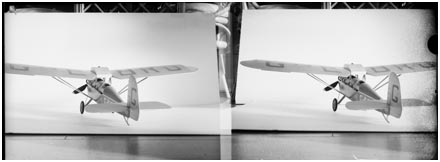
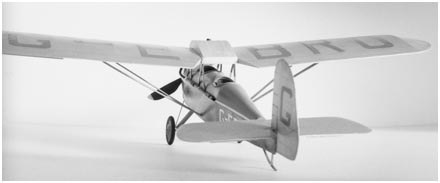
This is a test of the close up stereo ability. First off, apologies for the terrible damage to the film stock on the right hand edge, the film had been pushed too far into the fridge and frozen itself to the back, resulting in this mess. This is the whole plate and the subject is a model aeroplane Westland Widgeon fairly close in. This was the very first shot with the camera to test out the processing too. Not expecting much I didn't make a mental note of the exposure, although I would have certainly have stopped down as far as I felt possible given the depth of field at this close range. The use of the ground glass screen and some kind of stand is essential when using the camera in this form. |
|
Selective enlargement of right hand image. Note that although this image appears on the left of the plate, that's only because it's the right way up, in camera it would be upside down and hence the right hand image. Now this is very promising, both halves have closely balanced exposures (it's not always so with stereo cameras) and the lenses appear sharp. The stereo effect is truly impressive but impossible to appreciate unless you have a viewer. However, for you keen stereo photographers out there who have red/blue anaglyph glasses, all the following stereo images have an anaglyph page, clicking on any appropriate image will open that page in a separate browser window. In conclusion, the Kosmo Clack is brilliant at close up stereo photography and well worth the effort expended. The model is of a Westland Widgeon of the 1920s, half scratch built and modified from a West Wings kit from 1992, it's been flown many times. |
|
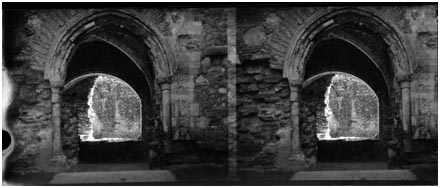
Next up is this full plate showing the standard lens stereo pair. This subject was chosen deliberately to reveal the differing distances of these multiple arches at the ruins of Netley Abbey in the UK, taken in July 2024. Netley Abbey is one of many such ruins across the United Kingdom that fell foul of King Henry VIII during the dissolution of the monasteries, Netley succumbing in 1536. |
|
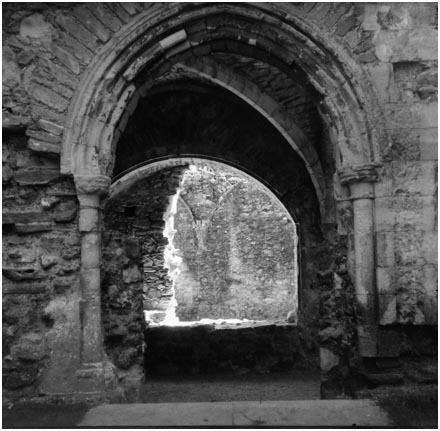
The image was made hand held using only the pop up viewfinder to aim. A little adjustment is clearly needed as the top of the arch has been lopped off when I thought it was in shot. This image shows the left hand of the pair in this case, but again the anaglyph is available. The sense of depth works well and the detail resolved by both lenses is impressive. One lens is softer than the other, the one with a large bubble inside f.11 arc, but not noticeable unless being very picky. For those not aware, an anaglyphic image is one where the left and right stereo images are combined but separated by colour, usually Red/Blue which is my preference or Red/Green. When this image is viewed through the appropriate coloured glasses the stereo effect is revealed in all its magnificence. It works particularly well on computer monitors but best without any surrounding screen clutter. |
|
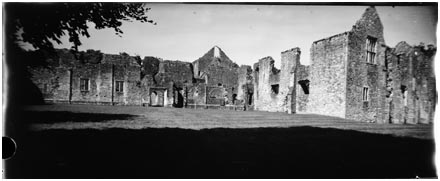
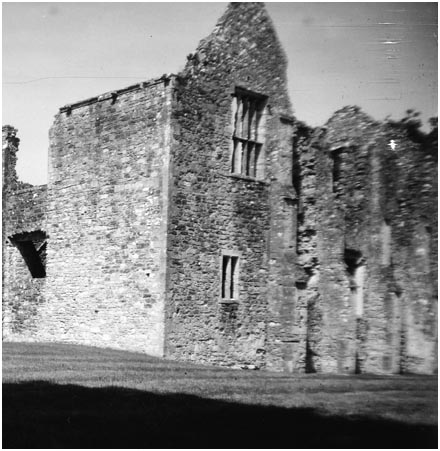
Now for the standard wide view. For this the lens and shutter assembly is unlocked and slid over to one side, causing one lens to be centred over the full plate to produce a wide but non-stereo view. Again hand held using the viewfinder, as you can see it's aiming high and I've cut off the gable, It's also a bit off vertical and I'm not altogether sure I can blame the camera for that. I was curious to see how the edge to edge definition fared. It's fair to say that Rietzchel were pushing their luck expecting the lens to resolve out to the edges across the full plate. Even at f/22 the definition rapidly collapses as you approach 20% plate width. But all the same it promises interesting images. |
|
A selective enlargement of the previous image shows how the image definition falls off a cliff. The individual stones remain clear out to the top Tudor window but by halfway across the window it's falling off and by the right hand edge, lost altogether. In fairness, it's asking a lot. It's also aggravated by one of the difficulties in using these old cameras with cut film as revealed by the scratches in the top right corner. Glass plates remain perfectly flat whilst cut film can ripple a bit, coming off the focal plane to the detriment of focus and being vulnerable to being scratched by the dark slide. |
|
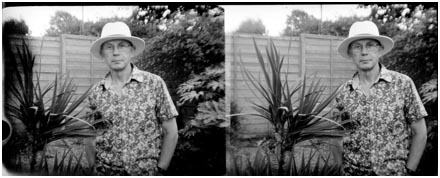
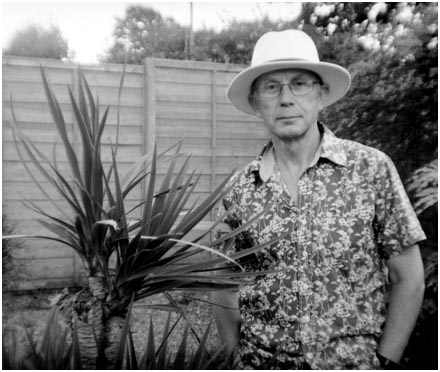
For the long focus stereo I thought it may suit a portrait shot, thinking that the longer 13cm focus would blur the background agreeably. Exposed at f6.3 the effect isn't as pronounced as I'd hoped, but here it is. |
|
Would have been better if the distracting fence had blurred out. It's not an unreasonable idea, but you can't rely on it to blur out anything moderately close to the subject. The stereo effect remains decent though. The biggest issue is the need to remove the lens and shutter assembly to remove the rear elements, you're at risk of dropping them and letting dust enter places it really ought not. This is the left hand image as it was least damaged by the frosting. The views are significantly offset from one another and for the anaglyphs I only use the section of the image covered by both pairs, a policy I adopt for all anaglyphs. |
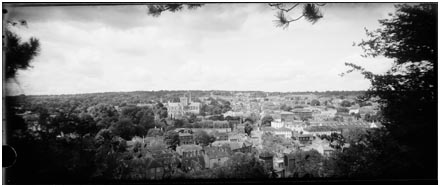 |
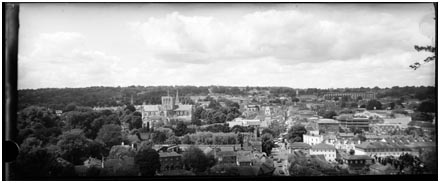
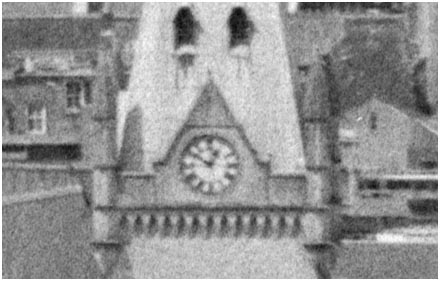
The final test is for the long focus wide view. To give a good comparison with the standard focus wide view, two plates were exposed tripod mounted from the same position, these are the whole plate areas. The top image was exposed with standard 6.5cm setup, whilst the bottom was using 13cm setup. Both were exposed at f.15 with compensation for the longer focal length accomplished by using a slower shutter speed. At standard length we are right at the limit of the image disc as betrayed by the darkening into the corners, but also disguised by the wider view including the undergrowth. Unsurprisingly, everything in the long focus image is twice the size as the standard including the image disc hence no visible vignetting into the corners. This view takes in the Cathedral in Winchester, UK from the viewpoint at St. Giles Hill. Unlike Netley, it avoided demolition at the hands of Henry VIII and remains in use to this day. Somewhere just right of centre is a clock tower, lets look a little closer... |
 |
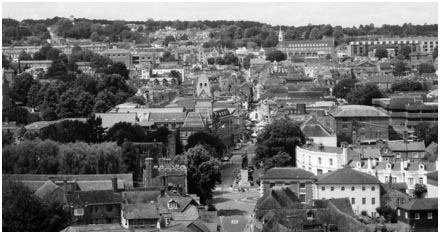 |
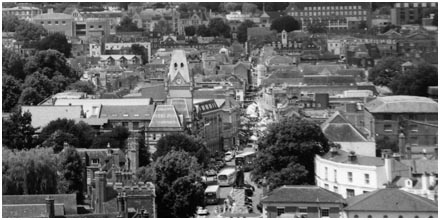
Selective identical enlargement factors from the same two negatives, both representing about 30% of the usable area. Top is the standard 6.5cm focal length. In the centre of the negative the clarity is just fine, it decreases towards the edges as shown earlier, but it's fairly impressive, if you were minded you could print this a metre long and not be offended. The lower image is from the 13cm setup, there's more detail as you'd expect and no discernible reduction of resolution, this is probably the best use the wide view function the Kosmo Clack offers. |
 |
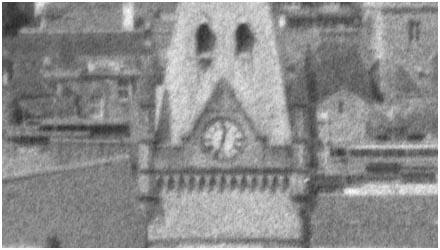 |
The same two negatives enlarged to the point that the film grain is obnoxious. In the upper image the clock face is 0.25mm across on the negative and it's 12:35 Clearly it took 15 minutes to replace the dark slide, remove the film carrier, check focus, adjust shutter speed, insert new film carrier, withdraw dark slide and wait for the clouds to pass over so that the lighting is similar to the previous exposure. This image has a fraction more contrast, but there are so many variables It's hard to attribute this to the camera. The clock face is 0.5mm on the negative. The Kosmo Clack is a cracking little camera, beautifully built and whilst a challenge to use, there are rewards for your efforts. If you have one collecting dust, it's time to dust it off.
|
 |
|
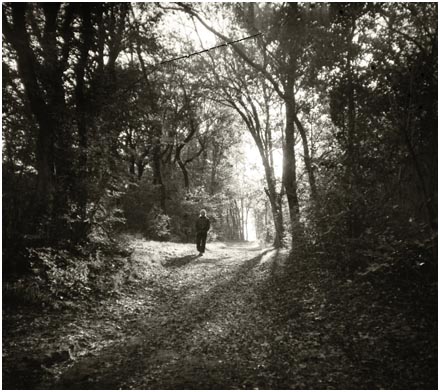
A ride out to the farthest staion on Vienna's U4 metro will take you Wien Hutteldorf. From here an energetic walk up through the woods will take you to a view across the city from Markwardstiege. The Rietzchel was dragged around Vienna in October 2024, unfortunately I had a bad case of dust from the carriers. It looks to be rust up inside the slide guides. So all I have to show for my trip is a handful of one sided stereos pairs, but at least something survived. I have since run glasspaper into the guides in a hope to clean out any further rust hiding in there and cleaned out the felt seals too. Try again in Spring. |
 |
|
|
 |
||

|
||
© Living Image Vintage Camera Museum 2000-2026