Back
|
Back
|
| KMZ Moscow 2 (Moskva 2) 120 roll film coupled rangefinder camera, results gallery |
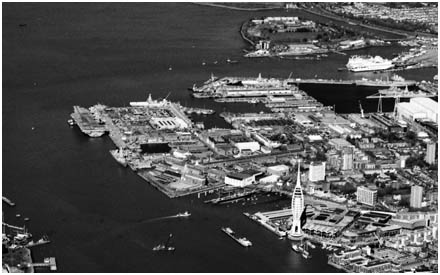 |
This Moscow 2 camera previously belonged to Ivan Karavaev, a pilot and deputy head of Soviet Naval Aviation. Politically, we'd have been unlikely to see eye to eye, however in his memory I contrived to take his old camera on an aerial photography outing to photograph the Royal Dockyard at Portsmouth, taking in one of the UKs newest aircraft carriers being provisioned dock side. I think he'd appreciate the thought. Exposed at 1/100th sec. at f11 with the the original yellow filter attached on 18th March 2026. Sadly this wasn't fast enough to freeze the engine vibrations from the 1960 Aircoupe used for the sortie, the lens has a focal length of 105mm - so does need to be free of vibrations to get clear images. In hindsight, I'd have been better off using 1/250th at f/8 for this image. |
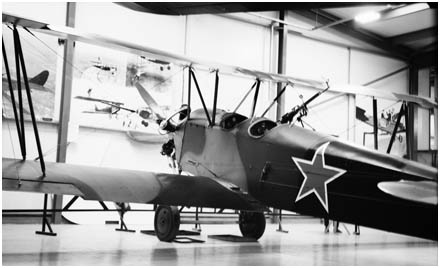 |
The Polikarpov Po2 biplane is an aircraft Ivan likely encountered during his training in the lead up to WW2. Ivan went on to fly fighters, being one of the pilots flying top cover at Yalta during the meeting between Stalin, Roosevelt and Churchill, February 1945. This Po2 is maintained in airworthy condition at Old Warden in Bedfordshire, I went there specifically to photograph it with the Moscow 2. The exposure was a rather long half a second at the widest aperture available of f/4.5. Being hand held, there is a slight double image, but I just about got away with it. |
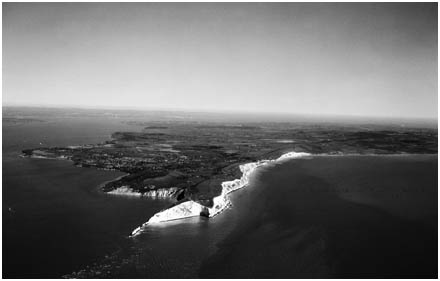 |
"The Needles", the chalky rocks that extend from the western tip of the Isle of Wight on the South Coast of the UK. At this point we are flying eastbound to Portsmouth Docks just visible in the far distance, to take the first image on this page. Exposed at 1/100th and f/11, the original yellow filter that came with the camera was used ostensibly to put some shape into the cloudless sky. It also darkened up the water appreciably, making the cliff somewhat stark. |
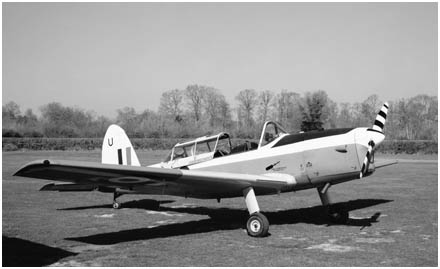 |
Also visiting Old Warden was this De Havilland Canada DHC1 Chipmunk, the first example of which dates from 1949, so older than the Moscow 2 camera that captured it on 19th March 2026. Used by the RAF as an ab initio trainer for many years, considerable numbers have found their way into preservation and private hands. Pilots generally adore it and I dare say Ivan would loved to have thrown one all over the sky as they are fully aerobatic. The negative is pretty sharp, all the aircraft stencils are clearly readable on the original. |
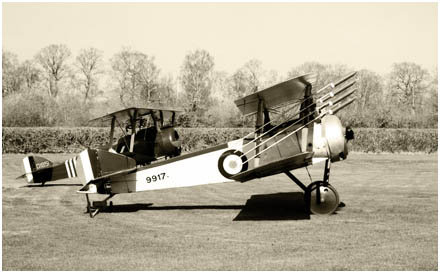 |
Somewhat older that the Moscow 2 camera, is this WW1 Sopwith Pup, again at Old Warden. Seen here sporting anti Zeppelin rockets. This particular aeroplane was actually built post WW1 as a Sopwith Dove, just ten were built. This was a two seat conversion of the Pup. It was rebuilt to represent a Pup in the 1930s. Behind lurks a Sopwith Camel. This image was sepia toned to delineate a different era for this page. |
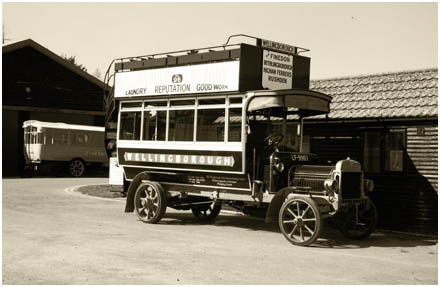 |
Same approach used for this very early bus, also to be found at Old Warden, I hope the leaf springs could soak up the road vibrations, as those tyres are solid and the seats are unpadded wooden slats. |
 |
An aeroplane that Ivan probably never got to try out is the Mikoyan Gurevich MiG 21, although he'd likely have loved the opportunity. The only thing in this image that is even remotely airworthy is the chicken shading itself under this exhibit to be found near Ton Son Nhut, Saigon. This airframe is a survivor of many supplied to the North Vietnamese Air Force by the Soviet Union during the Vietnam War. Survivor it may be, but it's hanging on by a thread, massive exfoliation corrosion in the upper and lower wings skins has resulted in them peeling back allowing the humid environment to attack the inner structure to the point that the chicken has no idea the peril it's in. |
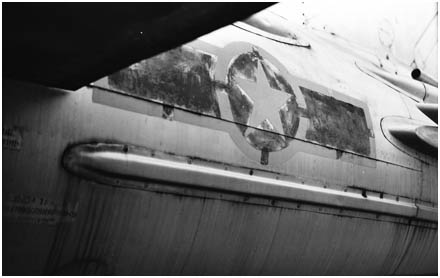 |
The remains of the NVAF markings on the rear fuselage of the MiG 21 fading into history. |
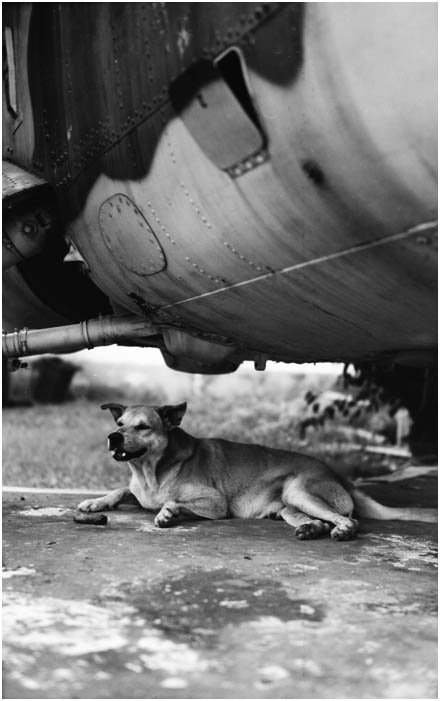 |
A semi feral dog bares his teeth to prevent me coming closer as he guards his snack beneath the shade of a Soviet Mil 24 helicopter, also in Saigon. Once a formidable thing, this Mil 24 can no longer bare its own teeth as it now shares a similar fate to its brother in arms, the Mig 21, above. February 2026. |
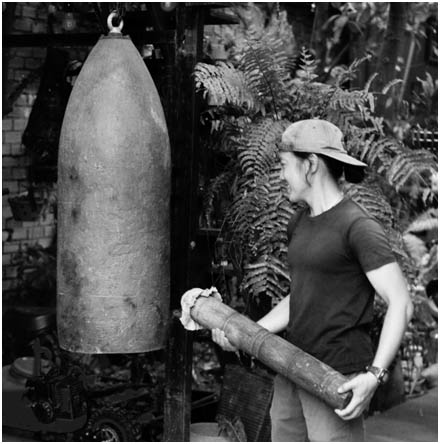 |
This is an American 500lb bomb dropped in Vietnam but was clearly anti war, as it failed to detonate. After spending several decades buried it was dug up and de-activated, having the tail, charge and detonator removed. Then it was carefully ground with a grinder internally to tune it. It now serves as a wonderfully resonant gong, here being demonstrated by its creator Duc. He tells me that his ultimate aim is to acquire six, all tuned differently to make an enormous instrument. I can't think of a better use for a bomb. |
 |
25 years ago the Cyclo was a common form of public transport around the streets of Saigon. Technically we ought to refer to it as Ho Chi Minh City, but expats and many locals alike still refer to it by its old name, and the international Airport still has the ICAO code of SGN. The Moscow 2 recorded this cyclo between trips just outside the old French Colonial Hotel Continental, where the war correspondents would hang out during the American War, as the Vietnamese call it. Once common the cyclos are rather rarer these days, mostly transporting tourists and banned from the centre of town as they slow up traffic in the increasingly congested city centre. |
 |
Reclining Buddha near Phat That Luang, Ventiane, Laos. Phat That Luang Temple, is seen as the symbol of Laotian sovereignty. Laos gained it's independence from France in 1954, the year the Moscow 2 camera that took this image was made, and the reason it was used on this trip. |
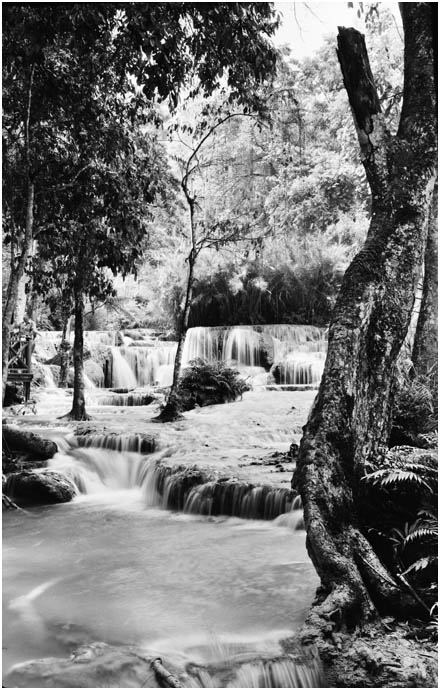 |
Kuang Si Waterfalls, near Luang Prabang, Laos. |
 |
Close by the waterfall above, local children play outside one of the innumerable temples scattered around the country. The Moscow produced a four rolls of films during this trip and consistently both top and bottom edges were exposed more, the strip ran into the film for about 4-5mm. I'm still perplexed by this and thought it was a reflection. But the film used for the aerial images at the top of the page showed no evidence of this. The only real difference being that the film was only in the camera for a couple of days for the aerial pictures, but may have had three or four days to sit in during the Laos trip. The only other difference was that the films were processed two at a time for Laos and in a single tank for the aerials. |
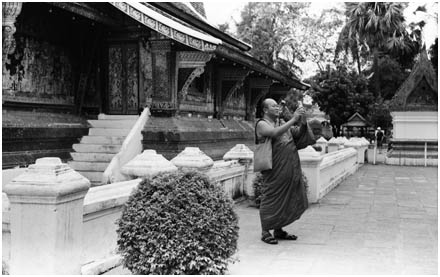 |
A Buddhist monk, whilst avoiding most trappings of modernity, finds a mobile phone indispensable, using it to record the temple, below. |
 |
Wat Xieng Thong (Temple of the Golden City) in Luang Prabang, Laos. |
 |
A herd of very content water buffalo cool themselves in a mud pit, also in Laos. |
 |
|
|
 |
||

|
||
© Living Image Vintage Camera Museum 2000-2026