Back
|
Back
|
| Test shoot, Dragon No.VI film stock, Svema cine film. Rated 64ASA, exposed as such. |
|
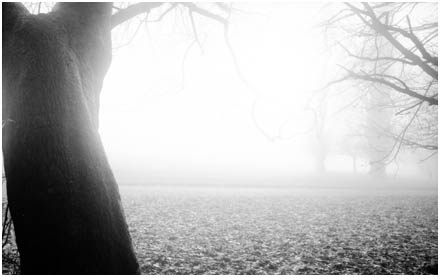
Okay, let's get the caveats out of the way. I am in no way a master photographer, I break lots of rules and am not exactly disciplined in my approach. Most of my photographs are taken with ancient relics from my donkey sanctuary camera museum. All exposures are based on the film speed indicated on the packaging, however, all exposures are also guessed by eye, I do not use any form of exposure meter, as this was how most people did it back in the day. Generally I favour a bit of overexposure, if in doubt, add half a stop is my motto. Camera used for this test was a Leica, originally dating from 1939 when built as a Leica Standard, it was subsequently returned to Leitz in the 1950s to be rebuilt as a Leica IIIA. It was last overhauled in 2025. The lenses used were both Elmars in 50mm and 35mm focal lengths, the opportunity to try the 90mm didn't arise. The film was tank processed in ID11, one inversion every 15 seconds, emptying started 8:30 mins, stop bath dropped in at 9:00mins. The following images are straight scans, no exposure compensation. |
|
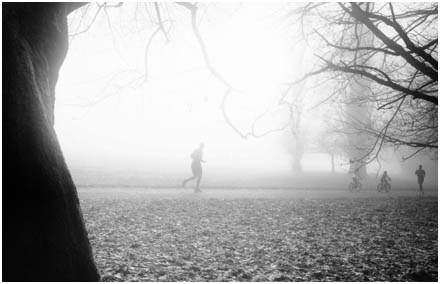
I didn't have a plan for the film, I just thought I'd see what grabbed my attention and run with it. The weather had been dire for several weeks but a day of freezing fog and clear skies but nil wind drew me out to Bitterne. The sun was low and burning bright into the fog, but with no breeze to mix the air the fog stayed low and glowed fiercely enough to make you squint. Both Elmar lenses are showing their age with a good deal of scratches, but both are also as clean as they are ever likely to be having been stripped and cleaned in the last few months. There's a good deal of flare in these two images, but it was freezing cold and we are directly into a low sun into fog, the sun is actually in frame, so I am really pushing my luck. Most of the flare is likely to old lens, but I don't mind particularly. The films are supplied as 24 exposure, now I have to admit to thinking that was a bit mean for the price when received, but the very thin base meant that the Paterson spiral was struggling to drive the film, so 36 exposures probably wouldn't work, for this reason Dragon films are probably right to supply these thin based films in shorter lengths. Having said that I actually got 26 out of this roll, and that was with cutting a Leica leader. |

|
I'm posting most of the film, but not all as I didn't get permission where people might be identified. If the lens was in better shape the twig in the foreground would have been darker in this shot, but compositionally it's weak anyway, so let's move on. |
|
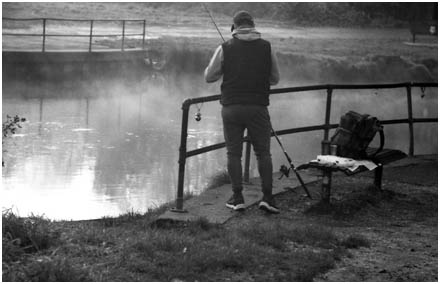
Now this was in fact the first frame off the film, but little matter. I just shot this one off to make sure the leader was gone, but was taken with the mist coming off the water backlit by the sun. The railings aren't suffering from the flare so much as the twigs above as the sun isn't actually in frame here. |
|
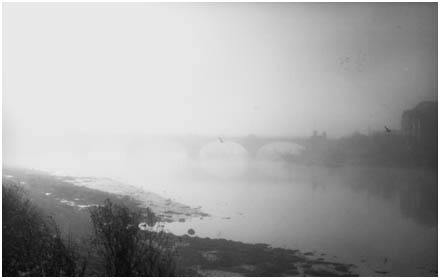
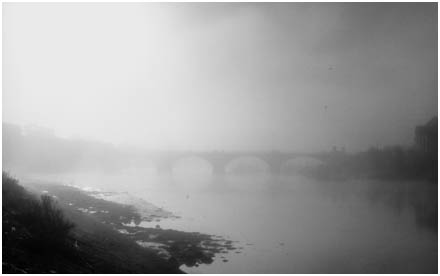
I'm very much drawn to the early industrial photographs from the 1870s taken with either Collotypes or wet process cameras. That was very much on my mind when I came across this scene, I'd loved there to have been a Thames barge heeled over awaiting the tide to turn. I attempted to encourage the local seagulls to fly into the large expanse of white in the top left, but whilst I was successful in getting a handful to wheel around the sky expectantly, they were smart enough to realize I hadn't any payment and somehow knew precisely what I wanted. So, of course, avoided that bit of sky entirely. |
|
Leaving aside the composition, which is lacking either a well positioned working boat or compliant seagull, the film had produced exactly what I'd have liked. The sun reflects off the mud flats confirming the film has recorded tones right into the highlights. The specs in the sky are neither dust or film issues, but two non compliant seagulls. |
|
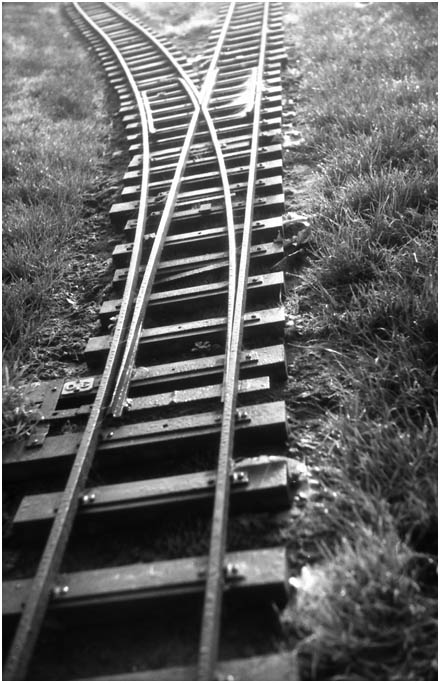
It looked better in the eyes than here. Focussing on the condensed water on the points I had hoped the depth of field was going to be shallower. This can be solved in the darkroom by angling the printing easel, but the composition is all a bit bleurgh, so maybe I wont bother. Exposure is fine though and the film has responded well enough, there's no fiddling here, No, actually I think I may give it some brutal angling treatment in the darkroom, maybe even curve the paper around a cylinder. |
|
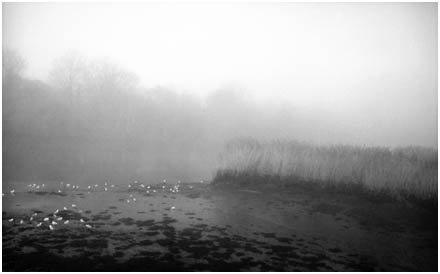
Again, I saw something here I haven't managed to capture. Despite being below freezing the scene glowed, probably helped along by the reeds that were a golden colour, so rather optimistic to convey that in monochrome. I waved my arms enthusiastically at the seagulls to get them to lift off and fill the flat sky with specs of texture. Their response, as you can see here, is lacking aeronautical enthusiasm. |
|
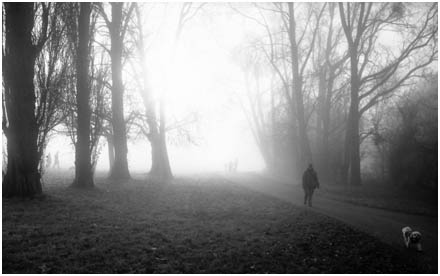
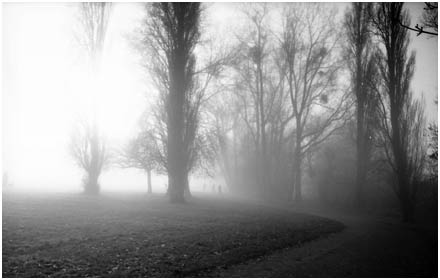
Right into sun, it's burnt out the tree entirely, but that's to be expected and I like it. |
|
Film has responded okay but the composition is uninteresting. |

|
Having walked a bit further along the mist was starting to lift but swirling around gently over the water. There are hints of something worthy here. It's not a composition likely to work, it's all rather central and I thought as much at the time, but it appeared the best from this viewpoint, the boats under the third arch have hints of those industrial images I admire. |

|
This design of this aeroplane started out in1937s as the Erco Ercoupe, a contemporary of the Leica. This particular aircraft is a late build example, being one of the last Fornaire produced examples in 1959, about the same time as our Leica was returned to Leitz to be rebuilt. The white striped propeller blades have some very noticeable flare, likely caused by the elderly 50mm Elmar. |

|
I just grabbed this image of our Christmas tree lights on a whim. Just the one exposure made, so I didn't really commit but I find the result reasonably intriguing. |
|
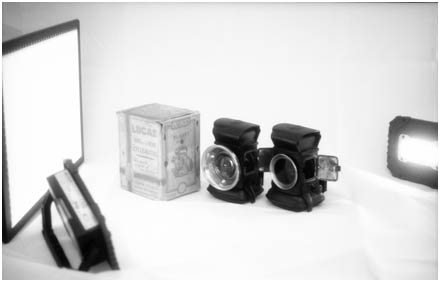
I thought I'd try out a bit of desktop studio work using these two Lucas cycle lights from the 1920s. |

|
It soon became apparent that this is not the Leica's forté, so I abandoned the idea. |

|
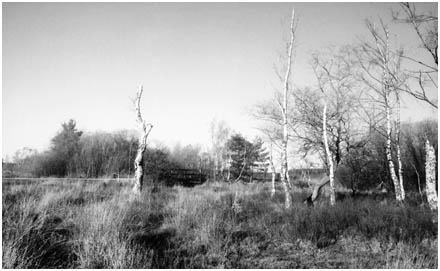
Another walk out in the freezing cold, this time to a pond in the New Forest, Hampshire. UK. Ordinarily in summer I'd be up to my waist in water in this spot, but the pond was frozen and was supporting my weight, so I wandered around looking at things from viewpoints not normally seen. This turned out to be an abject failure. The old rotten fence post in the foreground was supposed to be the primary feature. I'd hoped the thin wisps of grass would be crisp but the back ground blurred. Sadly I elected to use the 35mm Elmar to include the horizon, but that lens has rather too good depth of field, so the delineation is lost. Such things are readily apparent if using an SLR but the Leica user has to rely on skill and experience. So back to school for me. |
|
Correctly exposed is all I can say, having walked all the way out and frozen to death, I must have felt compelled to take a picture. The scene has absolutely no merit at all. Terrible, sometimes I think I should give up. |

|
As above, but overexposed into the bargain. Duh. |
|
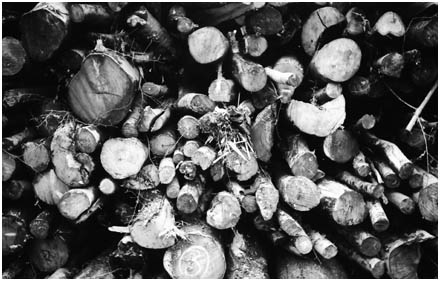
The woodmen have been at work near me thinning out the beech trees and piling them up. There's an imposing wall of felled trees. It would have been good to have a woodman posed against this heap to lend scale, but the place was quiet. It was very dark, the 50mm Elmar was used, wide open at f/3.5 and 1/40th for the exposure. |

|
By now the camera was indicating 27 frames and I expected each shot to be the last, just willing it to end, but it wound on again. I forgot to book some clouds to pass by, so the sky is a bit flat. |

|
The sun came out briefly on the low horizon, casting a shadow on the new decking, since my other passion is abstract graphic images I thought I'd explore the subject and became quite animated at the possibilities. Taking this shot I wound on and guess what, it drew taught, ending my first roll of Dragon film. This subject and lighting is something I am likely to revisit as I see some promise here. So far as the film goes, I'd quite happily suggest you try it out. There are no manufacturing blemishes, it behaves well and has great density and contrast. Grain is fairly fine, although 35mm users will tend to like a bit of grain, it's part of the joy of the format. Although I was a bit nervous the thin base might be vulnerable with a bottom loading Leica, it was perfect. I wouldn't suggest using it for film cocking cameras though, so the Voigtlander Vito family would be a miss. |
 |
|
|
 |
||

|
||
© Living Image Vintage Camera Museum 2000-2026