
Back
|
Back
|
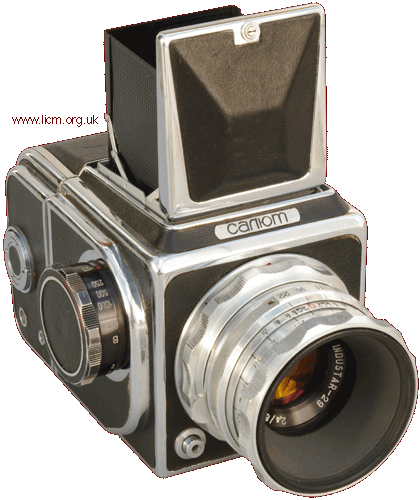
| Kiev Arsenal, Salyut (CANIOM) 120 roll film SLR Camera, late example 1973 |
|
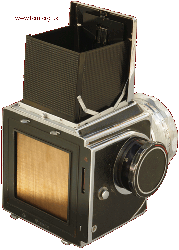
In the 1950s Kiev Arsenal were tasked to produce a professional medium format camera as the Soviet Union was lacking in this department domestically. The Salyut was the result. This is usually translated as "hello" in various sources, but it also means "firework". The Communists were keen on symbology and made use of it extensively, a firework being something that when released produces spectacular results, I'm currently putting this out there as a pet theory. The USSR never troubled itself with things like intellectual rights or copyright laws, so turned to the Swedish Hasselblad 1600F for what we will politely call, "inspiration". The inspiration Hasselblad camera initially saw the light of day in 1948, being their first serious attempt at a civilian camera and somewhat flawed from the outset. The Hasselblad evolved over time, attempting to resolve the inconsistent and delicate focal plane shutter issues, by 1952 they reduced the fastest shutter speed of 1/1600th to 1/1000th, but this wasn't enough and by 1957, Hasselblad gave up and went for a Compur leaf shutter variant and abandoned the focal plane shutter for twenty years. For whatever reason, Kiev Arsenal elected to copy the first version with all it's flaws, although limiting the shutter speed to 1/1500th. It wasn't a straight copy though, Kiev introduced a semi automatic aperture. The user preselected the correct aperture then selected fully open with a separate lever which locked. As the shutter button was pressed the aperture snapped shut, driven by a spring just before the shutter released. However, once you've locked it open, there's no way to close it again if you want to re-check the depth of field, you are committed to fire the shutter. The Salyut did follow Hasselblad practice, the camera itself being almost a cube, with separate film back, viewfinders and lenses fitted as required. Construction is a cast aluminium cube shell, into which the shutter crate is inserted, carrying the mirror and shutter mechanisms. The shutter blinds themselves follow Hasselblad practice, and the source of it's issues, being of extremely thin corrugated metal foil. In Salyut cameras this foil is an attractive looking titanium copper alloy. The corrugations allow the curtain to roll over the various rollers required. The very first examples had a self timer built in, but this was deleted fairly soon, then the camera showed up the exact same issues the 'Blad had, so Kiev limited the shutter speed to 1/1000th, certainly by 1968 although likely earlier. There are innumerable ways to kill a Salyut, the mechanism is very intolerant of anything remotely contrary to the instruction manual. An absolute DO NOT DO, is to change the shutter speed without having first cocked the shutter. Another is to make sure your hand is well clear of the shutter release as you wind on, if you accidently trigger the shutter during advance, the camera will become a pretty paperweight, or require a trip to Araxfoto. But, it's a handsome lump of a thing and oozes character. A full range of lenses were available, as well as prism finders. |
 |
|
This particular example was bought specifically for one purpose. To support Araxfoto in Kyiv, Ukraine whilst Russia does all it can to tear the city apart. ARAX, as they are popularly referred to, retain all the skills jigs and spares required to service the Salyut and derivatives to this day. I previously lived in Percherska district of Kyiv and walked past the old Kiev Arsenal works several time a week during 2019. Many times I wanted to concoct some excuse to drop in to ARAX and make their acquaintance, but didn't want to be a burden, as I had nothing to repair. COVID19 interrupted my stay and as I made plans to return in February 2022, the Russian invasion began and I never returned. This camera was acquired very cheaply as it had every problem a Salyut could have, but ARAX happily took it on with the brief to restore it to 1973 standard, with metal curtains - from their stocks of original parts. The camera found a way through the bombing of postal hubs, railways, power stations, water and gas supplies - an outbound journey of five weeks from the UK. ARAX rebuilt it and sent it back ten days later, the return journey taking a further week. ARAX also supplied a mint condition prism finder. Although rebuilt to original specification, I did take the advice of fitting additional flocking internally to cut down reflections. You can see some of the work documented in Project 18. The ARAX website where you can reliably get your Salyuts, Kiev 88s and other Arsenal cameras maintained. |
 |
|
Body No. 7304637 (first two digits are year of manufacture) |

|
|

|

|

|

|
 |
© Living Image Vintage Camera Museum 2000-2026