Back
|
Back
|
| Ensign Selfix 820 Folding 120 roll film camera. Photograph gallery. |
|
|
The first post restoration outing was to the small airstrip at Popham, Hampshire - 13/7/02. One roll was exposed in 6 x 9 cm format with a change to Kodak TMAX 100. All negatives were good and "lively", with the Ross lens performing quite well into the corners. There was no scratching from the film transport components (mind you, they had been polished the previous day) The depth of field is quite short, this being focused at 12ft at f/11, but this can be utilized as a very agreeable attribute. I was sure I didn't cut off that much of the blade when I framed the shot... The aeroplane is a 1939 Porterfield CP50, G-AFZL. |
|
|
Stopping down to f/22 dramatically deepens the depth should you require, the exposure being 1/25th in this case. The glow around the edge of the picture is a problem with the scanner, not the 50 year old camera. The aircraft is a DC3 (Douglas Commercial Type 3). Dating from the 30s there are still a few hundred going strong all over the world, this one serving with a small airline out of Bournemouth. |
|
|
After the third picture came out with too much foreground and not enough sky, I guessed there might be a problem. The viewfinder on top of the Selfix is very susceptible to damage - any slight bend in the base plate that acts as a stop for the front element of the viewfinder will dramatically effect the accuracy. This example was found to have a bend slightly less than 0.25mm, easily fixed if you know what to look for. |
|
|
All the previous shots were the full depth of the negative, the purpose here was to selectively enlarge a very small part of the negative to see how the Ross performed. The picture was exposed at 1/100th and f/11. The actual print was 10 x 8", had the whole negative been used - the print would have been 34" across. On the original, individual screw heads can be seen, which speaks quite well for the Ross Xpres. This despite no fewer than six air bubbles being discovered in the front element group and three in the rear, so much for the quality control at Ross in the 50s. |
|
|
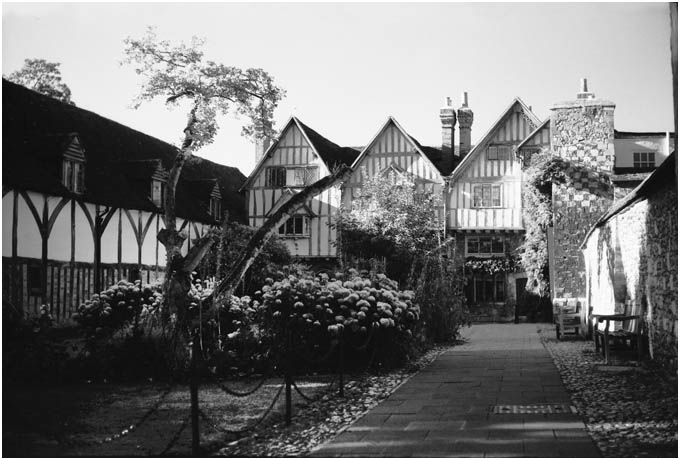
The old Ensign was whipped out of the display case, given an overhaul and a film dropped in for August 2025. For this image a dark yellow filter was fitted to see if that livened things up. Film stock was FOMA, not really a fan but it's cheap. The house at Priory Gate, Winchester UK is a tricky one to photograph, shooting into sun, between tourists and a low viewpoint is required to hide either a car or an unsightly wheeled bin, but this does at least push the foreground tree into the sky. |
|
|
Donnington Castle, Newbury. UK. After some time in the display case the old Ensign had very stiff focus grease, so the threads were cleaned and also the barrel was straightened as it always had a tight spot. The Selfix 820 is certainly good enough for the job. Certainly deserving of some film other than FOMA, although the film rollers could do with some attention as it appears that one is scratching the film. |
|
|
The "Needles" are the small group of rocks at the extreme western tip of the Isle of Wight, off the South coast of the UK. Photographed here from a broadly contemporary Forney F1A Aircoupe, G-ARHB on a 22 October 2025 trip. TheAircoupe is potentially a useful mount for aerial photography as the aeroplane can be flown with the canopy open to avoid reflections. |
|
|
From the same trip looking towards Portsmouth with the Isle of Wight on the horizon. This time shot through the canopy with attendant issues. I'm considering changing to Harman Kentmere stock as being reasonably priced and likely better as the FOMA stock always seems to have unexplained blemishes. Also the annoying blue dye that needs to be rinsed off prior to development if you don't want your multi shot ID11 to acquire the most fantastic hue. |
 |
|
|
 |
||

|
||
© Living Image Vintage Camera Museum 2000-2026